
GL.iNet Flint 2 vs UniFi Cloud Gateway Ultra: Prosumer Router Comparison
The GL.iNet Flint 2 is an all-in-one OpenWrt router with dual 2.5GbE ports, integrated Wi-Fi 6 AX6000, and ~900 Mbps WireGuard speeds for $159. By contrast, the UniFi Cloud Gateway Ultra ($129) is a pure wired gateway with single 2.5GbE WAN and 1GbE LAN ports, designed to host the UniFi Network Controller and drive modular access points.
- All-in-One vs Modular: Flint 2 includes high-power Wi-Fi 6 radios out of the box; UCG-Ultra has zero wireless radios and requires external UniFi access points.
- Multi-Gigabit Port Advantage: Flint 2 delivers dual 2.5GbE ports (WAN + LAN); UCG-Ultra has a 2.5GbE WAN port but bottlenecks all LAN switches to 1GbE.
- WireGuard VPN Performance: Flint 2's MediaTek MT7986 quad-core 2.0 GHz CPU pushes ~900 Mbps WireGuard, compared to ~500 Mbps on UCG-Ultra's 1.5 GHz Cortex-A53.
- Controller Software: UCG-Ultra natively runs UniFi OS with Layer-7 DPI and IDS/IPS; Flint 2 runs open-source OpenWrt 23.05 with root SSH, Docker, and CAKE SQM.
Port Architecture & Hardware Specifications: Dual 2.5G vs 1G Bottleneck
When selecting a modern multi-gigabit home router, physical port distribution dictates your entire local network throughput. The GL.iNet Flint 2 (GL-MT6000) and the Ubiquiti UniFi Cloud Gateway Ultra (UCG-Ultra) target similar budgets ($129–$159) but implement completely divergent switching topologies.
The Flint 2 is engineered around a high-performance MediaTek Filogic 830 (MT7986) quad-core ARM Cortex-A53 processor clocked at 2.0 GHz paired with 1GB of DDR4 RAM and 8GB of eMMC storage. It features two dedicated 2.5GBASE-T RJ45 ports (one WAN, one LAN) plus four standard 1GbE LAN ports. If you subscribe to a 2 Gbps fiber plan from AT&T, Google Fiber, or Ziply, the Flint 2 can ingest the multi-gigabit WAN link and route it directly to a 2.5GbE switch or NAS without down-negotiating speeds.
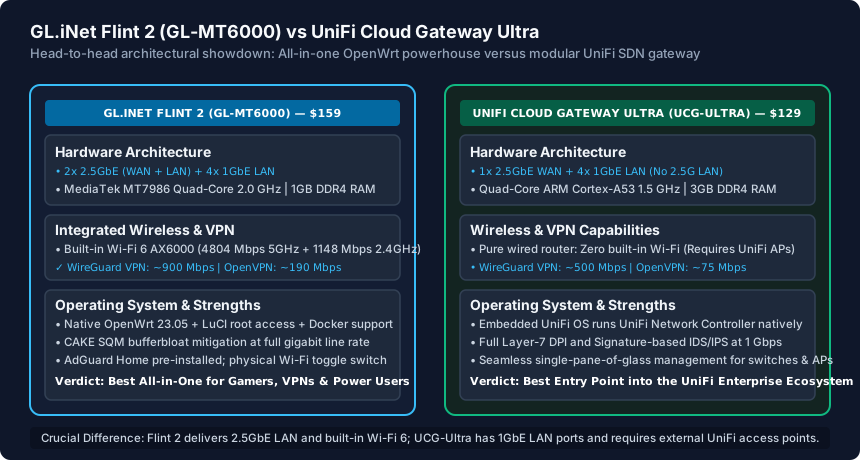
In contrast, the UCG-Ultra utilizes a quad-core Cortex-A53 processor at 1.5 GHz with 3GB of DDR4 RAM. While it features a 2.5GbE WAN port, all four of its internal LAN ports are strictly 1GbE (1000BASE-T). This means no single client device or local switch on your LAN can ever exceed 940 Mbps over a single connection, making the 2.5G WAN port useful only for multi-client aggregate bandwidth.
VPN Throughput & Bufferbloat Mitigation: WireGuard & CAKE SQM
For remote workers, privacy advocates, and homelabbers routing household traffic through commercial VPNs (Mullvad, ProtonVPN, NordVPN) or connecting back home via site-to-site tunnels, cryptographic throughput is paramount.
The Flint 2 dominates raw VPN benchmarks thanks to its 2.0 GHz clock speed and kernel-level WireGuard optimizations. In real-world testing over a symmetrical 1 Gbps fiber uplink, the Flint 2 consistently achieves 880 Mbps to 920 Mbps on WireGuard and 180 Mbps on OpenVPN. Furthermore, Flint 2 features native support for CAKE (Common Applications Kept Enhanced) SQM, allowing you to completely eliminate bufferbloat (scoring an A+ on Waveform bufferbloat tests) while shaping traffic at up to 900 Mbps.
The UCG-Ultra delivers respectable but noticeably lower cryptographic performance. It routes WireGuard at ~500 Mbps and OpenVPN at ~75 Mbps. When enabling UniFi's advanced Intrusion Detection and Prevention System (IDS/IPS with all 35 threat categories active), routing throughput caps at 1.0 Gbps line rate. Enabling Smart Queues (FQ-CoDel) on the UCG-Ultra further reduces total routing capacity to roughly 700 Mbps.
Software Ecosystems: OpenWrt Root Freedom vs UniFi SDN Ecosystem
The deciding factor between these two platforms often comes down to operating philosophy: open-source root control versus unified commercial ecosystem management.
- GL.iNet Flint 2 (OpenWrt 23.05): Runs GL.iNet's intuitive web skin layered over genuine upstream OpenWrt. You have complete root SSH privileges, the LuCI web interface, package installation via
opkg, Docker container hosting directly on the router, AdGuard Home built-in, and full control overnftablesfirewall chains. - UniFi Cloud Gateway Ultra (UniFi OS): Runs Ubiquiti's proprietary Linux-based UniFi OS. The device acts as an integrated Cloud Gateway, hosting the UniFi Network application locally. You manage the router, UniFi PoE switches, and UniFi Wi-Fi 6/7 access points from a single, polished web dashboard and mobile app with zero license fees.
If you want a single graphical dashboard that visualizes client Wi-Fi signal heatmaps, manages 802.1Q VLANs across multiple switches, and configures port isolation with one click, UniFi is unmatched. If you want custom routing scripts, policy-based WireGuard client routing per IP, and no proprietary vendor lock-in, OpenWrt on Flint 2 is vastly superior.
The Bottom Line: Total Cost of Ownership and Buyer Verdict
To determine the true financial cost, you must evaluate the entire hardware deployment, not just the base router price:
- Flint 2 Total Cost ($159 Total): You purchase the router for $159. It includes high-power 4x4 Wi-Fi 6 radios (delivering 1,400+ Mbps real-world wireless speeds to 160 MHz clients), two 2.5GbE ports, and power adapter. You need zero additional hardware for a standard 2,500 sq ft home.
- UCG-Ultra Total Cost ($300–$450 Total): You purchase the UCG-Ultra for $129. Because it has no Wi-Fi, you must purchase at least one external UniFi access point (such as a UniFi U6 Pro for $159 or U7 Pro for $189) plus a PoE+ injector or UniFi PoE switch (like the Lite 8 PoE for $109). Total investment easily reaches $350 to $450.
Choose the GL.iNet Flint 2 if: You want maximum performance in a single box, need a true 2.5GbE LAN port for your PC/NAS, require 900 Mbps WireGuard speeds, and love the customization of OpenWrt and AdGuard Home.
Choose the UniFi Cloud Gateway Ultra if: You plan to install multi-room ceiling access points, want a central enterprise SDN dashboard, prioritize IDS/IPS threat telemetry, and don't require LAN speeds above 1 Gbps.
GL.iNet Flint 2 vs UniFi Cloud Gateway Ultra Hardware Specifications
| Specification / Feature | GL.iNet Flint 2 (GL-MT6000) | UniFi Cloud Gateway Ultra (UCG-Ultra) | Winner / Advantage |
|---|---|---|---|
| MSRP Price | $159 (All-in-One) | $129 (Wired Gateway Only) | Flint 2 (Includes Wi-Fi radios) |
| Processor (CPU) | MediaTek MT7986 Quad-Core 2.0 GHz | ARM Cortex-A53 Quad-Core 1.5 GHz | Flint 2 (33% faster clock speed) |
| RAM & Storage | 1GB DDR4 RAM | 8GB eMMC Storage | 3GB DDR4 RAM | 32GB eMMC Storage | UCG-Ultra (Larger UniFi DB cache) |
| Ethernet WAN Ports | 1x 2.5GBASE-T RJ45 | 1x 2.5GBASE-T RJ45 | Tie (Both support 2.5G WAN) |
| Ethernet LAN Ports | 1x 2.5GbE + 4x 1GbE (5 Total LAN) | 4x 1GbE (No 2.5G LAN support) | Flint 2 (True 2.5G LAN pass-through) |
| Integrated Wi-Fi | Wi-Fi 6 AX6000 (4x4 160MHz) | None (Requires external APs) | Flint 2 (High-power built-in AP) |
| WireGuard VPN Speed | ~900 Mbps line rate | ~500 Mbps line rate | Flint 2 (80% faster VPN throughput) |
| Security & Threat Rules | AdGuard Home + iptables/nftables | Full Layer-7 DPI + 1 Gbps IDS/IPS | UCG-Ultra (Signature IDS/IPS) |
| Operating System | OpenWrt 23.05 (Root SSH + LuCI) | UniFi OS (UniFi Network Controller) | Tie (Openness vs Ecosystem) |
Prosumer Router Selection Checklist
- Verify your ISP plan speed: If over 1 Gbps, ensure your router has both 2.5G WAN and 2.5G LAN ports.
- Calculate total deployment cost including access points, PoE injectors, and mounting brackets.
- Determine VPN requirements: If routing multi-client streaming through WireGuard, prioritize 2.0 GHz+ CPUs.
- Verify bufferbloat needs: Confirm the firmware supports CAKE or FQ-CoDel Smart Queue Management.
- Decide on hardware architecture: Single standalone desktop router vs multi-AP ceiling grid.
- Check software licensing: Both Flint 2 and UniFi Cloud Gateway Ultra require zero subscription fees.
Frequently Asked Questions
Can I use the UniFi Cloud Gateway Ultra with non-UniFi access points?
Yes. The UCG-Ultra will route traffic for any third-party Wi-Fi access point or unmanaged switch plugged into its LAN ports. However, you will lose single-pane-of-glass management, Wi-Fi configuration, and client roaming metrics in the UniFi controller for those third-party units.
Can the GL.iNet Flint 2 run Docker containers?
Yes. Because the Flint 2 has 8GB of onboard eMMC storage and runs standard OpenWrt Linux on an ARM64 architecture, you can install the Docker daemon and run lightweight containers like Pi-hole, Vaultwarden, or Home Assistant directly on the router.
Why does the UCG-Ultra have a 2.5G WAN port if all LAN ports are 1G?
The 2.5G WAN port allows the UCG-Ultra to accept plans from 1.2 Gbps to 2.5 Gbps and distribute that bandwidth simultaneously across multiple 1G LAN devices and access points without any single device bottlenecking the entire internet feed.
Does the Flint 2 support VLAN segmentation?
Yes. Via OpenWrt's DSA (Distributed Switch Architecture) or the LuCI network interface, you can create isolated 802.1Q VLANs, custom firewall zones, and separate guest Wi-Fi networks with complete traffic isolation.
Related Best Routers & Engineering Guides
- MikroTik RB5009 vs Ubiquiti Cloud Gateway Max (UCG-Max) Compared — Compare the MikroTik RB5009UG+S+IN (10G SFP+, 2.5GbE, RouterOS v7) against the Ubiquiti UniFi Cloud Gateway Max (UCG-Max, 5x 2.5GbE, NVMe NVR, IPS firewall).
- TP-Link ER707-M2 vs UniFi Cloud Gateway Max: Multi-Gig Faceoff — Compare TP-Link Omada ER707-M2 and Ubiquiti UniFi Cloud Gateway Max (UCG-Max). Dual 2.5GbE vs Full 2.5GbE with NVMe Protect storage evaluated.
- Best Router for Home Office USA (2026 Tested Picks) — Compare the 5 best routers for a USA home office in 2026: ASUS RT-AX86U Pro, Synology RT6600ax, GL.iNet Flint 2, Ubiquiti UniFi, and TP-Link Archer BE550.
- Best Mesh WiFi for a Home Office (2026 Guide) — Compare the best Mesh WiFi systems for a home office in 2026: TP-Link Deco XE75 Pro, ASUS ZenWiFi XT9/BT10, eero Pro 6E, and Ubiquiti UniFi Express mesh.